How to Get an STR Permit in Temecula: The 2026 Owner’s Compliance Guide
 allurahomesSeptember 17, 202616 min read
What if your high-end investment property isn’t actually a business, but a $1,000-per-day liability waiting to happen? In the Temecula Valley, your specific address is the difference between a high-yield asset and a legal nightmare. You likely understand that this region offers incredible revenue potential, yet the regulatory landscape feels like a moving target. It’s frustrating to face the Wine Country lottery system or the strict prohibitions within city limits when you simply want to provide a premium guest experience.
This guide provides the definitive roadmap on how to get an STR permit in Temecula for 2026, ensuring your property remains protected and profitable. We’ll clarify the critical jurisdictional divide, break down the current Riverside County cap, and provide a step-by-step application checklist for your peace of mind. By the end, you’ll know exactly where your property stands and how to secure its future as a compliant, high-performing vacation rental. We’ve distilled the complex requirements into a logical framework so you can focus on hospitality rather than paperwork.
Key Takeaways
- Identify the critical distinction between the City of Temecula’s permanent STR ban and the permitted zones within Unincorporated Riverside County.
- Master the exact roadmap for how to get an STR permit in Temecula wine regions, including mandatory site plans and specific insurance requirements.
- Prepare for 2026 operational mandates, such as the 60-minute local contact response rule and strict maximum occupancy enforcement.
- Navigate the complexities of the Riverside County permit cap and lottery system to determine your property’s eligibility in high-demand areas.
- Leverage professional stewardship to mitigate the risk of $1,000 daily fines while ensuring your investment remains both compliant and profitable.
The Temecula STR Trap: City vs. Unincorporated Riverside County
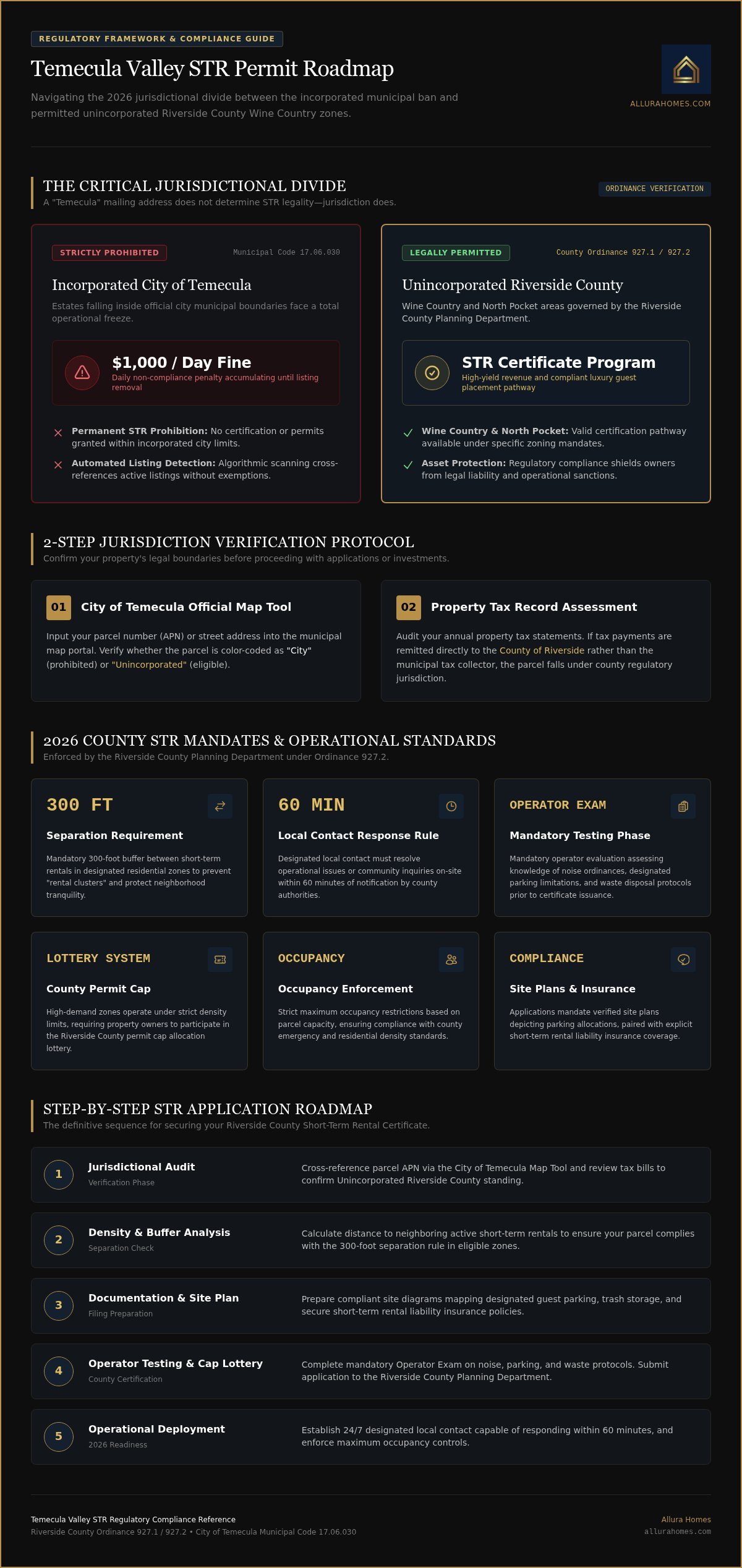
The most common pitfall for new investors is assuming a “Temecula” mailing address grants the right to host. It’s a costly misconception. The geographic reality is that many properties with Temecula zip codes sit outside the City of Temecula municipal boundaries. If your property falls within the incorporated city limits, you face a permanent ban on short-term rentals under Municipal Code 17.06.030. Operating without authorization here isn’t just a minor oversight; it carries a staggering $1,000 daily fine that accumulates until the listing is removed.
Conversely, the neighboring “Wine Country” and “North Pocket” regions operate under the jurisdiction of Unincorporated Riverside County. These areas offer a legal pathway for owners, provided they follow strict regulatory protocols and respect the local community character. Understanding how to get an STR permit in Temecula starts with confirming which side of this invisible line your property occupies. We view this jurisdictional clarity as the first step toward high-yield revenue and long-term asset protection.
How to Determine Your Jurisdiction
Your first step is verification. Don’t rely on your mailing address. Instead, utilize the City of Temecula Official Map Tool. By entering your parcel number or address, you can see if your land is shaded as “City” or “Unincorporated.” Additionally, review your property tax records. If you pay taxes to the County of Riverside rather than the City of Temecula, you’re likely in the clear to apply for a permit. This distinction is the foundation of your compliance strategy. Many owners discover that their “Temecula” estate is actually governed by the county, opening doors that seemed closed.
The Legal Landscape for 2026
For properties in the county, Riverside County Ordinance 927.1 governs your operations. In 2026, enforcement has reached a peak level of sophistication. Authorities now use automated scanning tools to cross-reference listings against active permits. This makes the question of how to get an STR permit in Temecula county land more urgent than ever. Compliance isn’t a suggestion; it’s the barrier to entry for the high-end market. Professional stewardship ensures you meet these evolving standards without the administrative headache.
Short-term rentals are strictly prohibited within the incorporated City of Temecula limits while being legally permitted in unincorporated Riverside County areas under specific zoning and certification requirements.
Riverside County STR Certificate Requirements for 2026
For estates located in the celebrated Wine Country and North Pocket regions, the path to legality runs through the Riverside County Short-Term Rental Program. Unlike the blanket prohibitions found within city limits, the county utilizes a structured certification process designed to balance tourism revenue with neighborhood tranquility. The Riverside County Planning Department serves as the primary arbiter for these applications, enforcing Ordinance No. 927.2 with meticulous scrutiny. Securing this certificate is the only way to shield your investment from enforcement actions while positioning your property for elite-tier guest placement.
Density management remains a cornerstone of the 2026 regulatory framework. To prevent “rental clusters” that disrupt the rural atmosphere, the county enforces a 300-foot separation requirement between short-term rentals in specific residential zones. This means your eligibility is often determined by the actions of your closest neighbors. Understanding how to get an STR permit in Temecula unincorporated land requires an immediate analysis of your parcel’s proximity to existing permitted units. It’s a precision game where early applicants often secure the limited available slots.
The Mandatory Operator Testing
The 2026 compliance landscape introduces a mandatory testing phase for all owners and operators. This isn’t a mere formality; it’s a comprehensive assessment of your knowledge regarding noise ordinances, parking limitations, and waste management protocols. You must demonstrate a clear understanding of the county’s expectations before a certificate is issued. This “Operator Exam” ensures that every host acts as a responsible steward of the community. Preparing for this acknowledgement process is significantly easier when you have a senior-level management partner to guide your operational strategy.
Zoning and Parcel Restrictions
Your property’s zoning designation is the ultimate gatekeeper. Most successful permits are issued for parcels zoned as Residential or Agricultural-Residential. However, the presence of a Homeowners Association (HOA) can override county permissions; if your CC&Rs prohibit short-term stays, the county will not issue a certificate. Additionally, 2026 rules clarify that most Accessory Dwelling Units (ADUs) built under recent state mandates are restricted to long-term housing only. Verifying these granular details before you begin the application prevents wasted resources and ensures your business model rests on a stable legal foundation.
Step-by-Step: How to Get Your Temecula STR Permit
Securing a permit requires more than just filling out a form; it demands a meticulous assembly of technical documents that reflect the high standards of your property. When considering how to get an STR permit in Temecula, your first priority is the creation of a professional site plan. This document must clearly illustrate designated parking spaces, outdoor amenities like pools or fire pits, and precise property boundaries. The county uses this to ensure your operation won’t negatively impact local traffic or safety. Precision here prevents the administrative friction that often stalls less-prepared applications.
Insurance is another non-negotiable pillar of your application. Standard residential policies often exclude commercial short-term rental activity, leaving you legally and financially exposed. You must provide proof of a specialized policy that specifically covers the unique liabilities of the hospitality industry. Additionally, the physical inspection is the final hurdle. County inspectors will verify the presence of interconnected smoke alarms, fire extinguishers, and, for high-end estates, compliant pool fencing and safety signage. These details protect both your guests and your legal standing as a professional host.
Documentation and Application Submission
Your submission package must be comprehensive to avoid costly delays. Ensure you have digitized copies of your government-issued ID, the recorded grant deed, and professional floor plans that indicate the square footage and intended use of every room. You’ll submit these through the Riverside County Planning portal. For a deeper dive into the specific legal nuances of this process, review our guide on Temecula Short Term Rental Laws: The 2026 Homeowner’s Guide to Compliance. This ensures your application is technically sound before it reaches an examiner’s desk.
Transient Occupancy Tax (TOT) Registration
Financial transparency is a core requirement for 2026 operations. You must establish an account with the Treasurer-Tax Collector to handle the collection and remittance of guest taxes. Familiarizing yourself with the Riverside County Treasurer-Tax Collector TOT requirements is essential, as the current schedule requires disciplined monthly reporting. Failing to remit these taxes on time is one of the fastest ways to lose your operating certificate. Compliance in this area isn’t just about taxes; it’s a prerequisite for your annual permit renewal. Understanding how to get an STR permit in Temecula means recognizing that your relationship with the tax collector is just as vital as your relationship with the planning department.
Operational Standards: Staying Permitted and Profitable
Securing your certificate is only the initial phase of a successful investment. Maintaining that status requires rigorous adherence to operational standards that Riverside County monitors with increasing precision. The most critical requirement for out-of-area owners is the “Local Contact” mandate. You must designate a representative available 24/7 who can physically respond to the property within 60 minutes of a complaint. This rule ensures that issues like noise or parking are mitigated before they escalate into formal citations. For many high-stakes stakeholders, this logistical demand is the primary reason to seek a professional partnership.
Maximum occupancy and parking are the two areas where most violations occur. Your permit will specify a strict guest limit based on bedroom count and septic capacity; exceeding this number is a fast track to permit revocation. Additionally, street parking is strictly prohibited for short-term rental guests in unincorporated areas. All vehicles must remain within the designated parking areas identified on your approved site plan. To remain compliant, you must also display your permit number and house rules on professional interior and exterior signage, ensuring transparency for both guests and county officials. If you are struggling with these 24/7 requirements, contact Allura Homes for professional compliance management.
Noise Monitoring and Nuisance Prevention
Noise remains the leading cause of neighbor friction and county intervention. We recommend the integration of sophisticated decibel monitoring technology, such as NoiseAware, to track volume levels in real time. These systems provide automated alerts when thresholds are exceeded without compromising guest privacy. Establishing clear boundaries for outdoor amenities, particularly pools and hot tubs, after 10:00 PM is essential. Our team prioritizes meticulous guest vetting to ensure that only respectful, high-tier travelers occupy your estate, significantly reducing the risk of noise-related incidents. Understanding how to get an STR permit in Temecula is only half the battle; preventing nuisances is how you keep it.
Trash and Maintenance Protocols
Riverside County enforces specific trash storage and pickup requirements to preserve the rural aesthetic of the Wine Country. Receptacles must be stored out of public view and only placed at the curb during designated pickup windows. Neighbor complaints regarding unsightly trash or poor exterior maintenance are logged by the county and can negatively impact your permit renewal. For a comprehensive look at optimizing these high-standard operations, explore our guide on Short Term Rental Property Management: The 2026 Guide to High-Yield Stewardship. Consistent, white-glove maintenance is the ultimate tool for both compliance and revenue growth.
Professional Stewardship: Why Management is the Ultimate Compliance Tool
Managing a high-end estate in the Temecula Valley requires a dual focus on guest experience and regulatory adherence. For many owners, understanding the technicalities of how to get an STR permit in Temecula is just the beginning. The real challenge lies in the perpetual maintenance of that permit through fluctuating county rules and strict reporting cycles. Professional stewardship transforms this administrative burden into a streamlined operational advantage. We ensure that your property doesn’t just meet the minimum legal requirements but operates as a premier, high-performing asset.
Allura Homes serves as your designated 24/7 Local Contact, fulfilling the county’s 60-minute response mandate with professional precision. This removes the logistical barrier for owners living outside the region. We also automate the complexities of monthly TOT reporting and annual permit renewals, ensuring your property never falls out of compliance due to a missed deadline. This level of oversight protects your license while allowing you to focus on the high-level performance of your portfolio. We treat your property’s legal standing with the same scrutiny as its revenue potential.
White-Glove Compliance and Permitting Services
We handle the exhaustive jurisdictional research and initial application process, navigating the specific zoning nuances of the Wine Country and North Pocket areas. Our team manages the entire permitting lifecycle, from the initial site plan creation to the final county inspection. Our approach prioritizes a “Good Neighbor” policy, proactively managing guest behavior and noise levels to maintain your property’s standing within the community. For a deeper look at our comprehensive approach, read our guide on Full-Service Vacation Rental Management: The 2026 Owner’s Guide to High-Yield Stewardship.
Improving Income Through Regulatory Safety
Discerning travelers increasingly seek out professionally managed, fully permitted homes for their security and standardized quality. A valid permit is more than a legal requirement; it’s a badge of reliability that attracts high-tier guests and justifies premium nightly rates. Long-term asset value is directly linked to this regulatory safety. A property with a clean compliance history is a far more attractive investment than one plagued by citations or unauthorized status. Secure your investment’s future and gain the peace of mind that comes with expert oversight. Schedule a consultation for your Temecula property today.
Secure Your Estate’s Future in Temecula
Your journey toward a high-yield investment begins with jurisdictional clarity. The distinction between the City of Temecula and Unincorporated Riverside County is the absolute foundation of your legal operation. Mastering how to get an STR permit in Temecula involves more than just initial documentation; it requires a commitment to the 2026 operational standards, from 60-minute response times to precise occupancy management. Compliance is not a hurdle to clear but a strategic asset that protects your property’s value and reputation.
With 13+ years of boutique hospitality experience, our team specializes in the nuances of Riverside County Ordinance 927. We act as your designated 24/7 Local Contact, providing the white-glove oversight necessary to ensure your estate remains a “Good Neighbor” while improving revenue. Don’t leave your investment to chance in an increasingly regulated landscape. Let Allura Homes Handle Your Temecula STR Compliance and provide the peace of mind you deserve. Your property is a significant asset. Treat it with the professional stewardship it requires to thrive.
Frequently Asked Questions
Are short-term rentals allowed in the City of Temecula in 2026?
No, short-term rentals remain strictly prohibited within the incorporated City of Temecula limits. This ban is enforced under Municipal Code 17.06.030, which applies to all residential zones within the city boundaries. Investors often mistake a Temecula mailing address for city jurisdiction, but if your property falls inside the city line, you cannot legally host. Operating an unauthorized rental here leads to significant daily fines and permanent enforcement actions.
What is the difference between a City and County STR permit in Temecula?
The primary difference is legality. The City of Temecula doesn’t issue STR permits because they’ve enacted a total ban. In contrast, Unincorporated Riverside County allows short-term rentals in specific areas like Wine Country. If your parcel is in the county, you must obtain a Short-Term Rental Certificate from the Riverside County Planning Department. This jurisdictional distinction is the most critical factor when researching how to get an STR permit in Temecula for your investment property.
How much does an STR permit cost in Riverside County?
Riverside County requires various fees for the initial application, annual renewals, and mandatory inspections. While these administrative costs are subject to periodic updates by the Board of Supervisors, they represent a necessary investment in your property’s legal standing. We recommend reviewing the current fee schedule on the Riverside County Planning Department portal for the most accurate figures. These costs are separate from the Transient Occupancy Tax (TOT) obligations you’ll manage throughout the year.
Do I need a business license for an Airbnb in Temecula Wine Country?
Yes, operating a vacation rental in the Wine Country requires a formal Short-Term Rental Certificate, which acts as your primary operating license. Additionally, you must register for a Transient Occupancy Tax (TOT) certificate through the Treasurer-Tax Collector’s office. This dual-registration ensures you are compliant with both land-use regulations and local tax laws. Professional management teams often handle these registrations to ensure every administrative detail is addressed with the precision required for high-tier hospitality.
What happens if I operate an STR without a permit in Temecula?
Operating without a permit carries severe financial and legal consequences. In the City of Temecula, unauthorized hosting triggers a $1,000 daily fine that continues until the listing is deactivated. In unincorporated areas, Riverside County uses automated scanning technology to identify unpermitted listings. Violators face substantial penalties, the potential loss of future permitting eligibility, and legal injunctions. Maintaining compliance is the only way to protect your long-term asset value and ensure uninterrupted revenue.
Can I get an STR permit for an ADU or guest house in Temecula?
Generally, Accessory Dwelling Units (ADUs) built under recent California housing mandates are restricted to long-term residential use only. Riverside County regulations typically prohibit the use of these units as short-term rentals to preserve local housing stock. However, older guest houses or secondary dwellings with specific historical zoning may have different paths. It’s essential to perform a granular parcel search to determine if your secondary structure qualifies for a permit before beginning the application process.
What is the “Local Contact” requirement for Temecula STRs?
The “Local Contact” mandate requires every permitted rental to have a designated representative available 24/7. This individual must be able to physically arrive at the property within 60 minutes to resolve guest issues or neighbor complaints. This is a non-negotiable safety and nuisance prevention rule enforced by Riverside County. Many owners partner with a professional stewardship team to fulfill this role, ensuring a sophisticated response that maintains “Good Neighbor” status and prevents permit citations.
Is there a cap on the number of STR permits in Temecula Wine Country?
Yes, Riverside County enforces density caps and separation requirements to prevent the over-concentration of rentals in rural neighborhoods. Specifically, new permits may be denied if another short-term rental is located within 300 feet of your property in certain residential zones. These caps make the timing of your application critical. Understanding how to get an STR permit in Temecula involves analyzing the current density of your specific pocket to ensure a slot remains available for your estate.
Related Articles
Continue reading about this topic.



Need Help Managing Your Rental?
Our team has 13+ years of experience improving revenue for California vacation rental owners.