Navigating California STR Zoning Laws: The 2026 Homeowner’s Strategy Guide
 allurahomesAugust 20, 202617 min read
In 2026, the era of “asking for forgiveness rather than permission” in the California rental market has officially ended. With the full implementation of Senate Bill 346 and aggressive local enforcement, a single administrative oversight can now result in fines reaching 2,000 dollars per day. You understand that your property is more than just a building; it is a sophisticated investment that requires meticulous stewardship. However, the friction between state-level housing goals and restrictive city ordinances often creates a fog of uncertainty. Successfully navigating California STR zoning laws is no longer just a legal necessity. It is a strategic asset for the discerning homeowner who values long-term stability over short-term gambles.
You deserve a professional perspective that treats your asset with the same level of scrutiny and care as you do. This guide promises to demystify the complex regulatory landscape, providing a clear “yes or no” understanding of your property’s eligibility and a precise roadmap for maintaining a legal permit. We will examine the specific 2026 requirements for major markets like San Diego and Palm Springs, analyze the impact of new data-sharing mandates, and outline a professional strategy to ensure your portfolio remains both compliant and highly profitable.
Key Takeaways
- Understand the “Home Rule” authority that allows individual cities to create unique regulations, ensuring you look beyond state-level generalities for local compliance.
- Distinguish between residential and commercial zoning overlays to determine if your property meets the specific primary residence or density mandates required for a permit.
- Master the administrative requirements of the triple-threat, which includes STR permits, business licenses, and TOT registration, to protect your investment from costly daily penalties.
- Successfully navigating California STR zoning laws involves a strategic verification of both municipal codes and private HOA covenants to ensure total operational certainty.
- Leverage professional stewardship to handle the meticulous details of permit renewals and compliance monitoring, allowing you to focus on high-tier hospitality and revenue growth.
The 2026 California STR Regulatory Framework: State vs. Local Control
California operates under a robust “Home Rule” doctrine. This legal principle grants individual cities and counties the authority to create their own ordinances, provided they don’t conflict with state law. For homeowners, this means that the rules governing a property in San Diego may be entirely different from those in Palm Springs or Napa. While the state provides a broad framework, the granular details of zoning and operation remain a local matter. This fragmentation is precisely why navigating California STR zoning laws requires a localized, meticulous approach rather than a one size fits all strategy.
The year 2026 represents a pivotal shift in how these local rules are enforced. With the implementation of Senate Bill 346, the era of anonymous hosting has ended. Platforms like Airbnb and Vrbo are now legally mandated to share host data, including physical addresses and local permit numbers, directly with municipalities. This transparency allows cities to utilize sophisticated digital tracking to identify non-compliant listings instantly. Professional stewardship is no longer optional; it’s a prerequisite for protecting your asset from the heavy fines that now accompany these advanced enforcement tactics.
Defining “Short-Term Rental” Under California Law
The legal boundary for a short-term rental is defined by the 30 day threshold. Any stay of 31 consecutive days or more typically falls under long-term tenancy laws, which triggers different zoning requirements and tenant protections. Within the STR category, cities often distinguish between “hosted” stays, where the owner remains on-site, and “unhosted” entire-home rentals. While a hotel is a commercial enterprise and a B&B offers lodging with breakfast in a residential setting, a short-term rental is a residential dwelling unit rented to guests for 30 consecutive days or less. Understanding these nuances is critical, as many cities have implemented strict caps on unhosted rentals to preserve local housing stock.
The Coastal Zone Factor: San Diego and Beyond
If your property sits within the California Coastal Zone, usually defined as 1,000 yards from the mean high tide line, you have a unique layer of protection. The California Coastal Commission (CCC) views STRs as “lower-cost visitor-serving accommodations.” Because the Coastal Act prioritizes public access to the shore, the CCC has historically limited a city’s ability to ban rentals entirely in these areas. However, this doesn’t mean a free pass. Owners in these zones often face a “Coastal Development Permit” (CDP) requirement. This administrative hurdle ensures that your rental doesn’t negatively impact coastal resources or public access. Gaining a foundational understanding of short-term rental regulations through this state level lens helps you leverage these protections when local ordinances feel overly restrictive.
Decoding Zoning Districts: Is Your Property Eligible for an STR?
Your path to a legal short-term rental begins with a single alphanumeric code: your property’s zoning designation. In the sophisticated landscape of California real estate, eligibility isn’t universal. While Residential 1 (R1) zones are often the target for vacation rentals, many major cities now impose “Primary Residence” mandates. In these jurisdictions, you must occupy the home for a significant portion of the year, typically 275 nights or more, to qualify for a permit. Conversely, Commercial (C) or mixed-use zones may offer more operational freedom, but they frequently come with higher fiscal responsibilities under the Short-Term Rental Tax Law, which can impact your net revenue projections.
To remove the guesswork from navigating California STR zoning laws, you should consult your city’s Geographic Information System (GIS) map. This digital tool provides a definitive overlay of your parcel. It reveals if you sit within an “Exclusion Zone” or a neighborhood subject to specific density caps. Identifying these boundaries early prevents the administrative burden of applying for a permit in a district where they are fundamentally prohibited.
Inland High-Demand Zones: Temecula and Palm Springs
Inland markets present unique regulatory hurdles that require a senior level perspective. For those eyeing the vineyard regions, a deep dive into Temecula short term rental laws is essential. Specifically, properties in Citrus Vineyard (C-V) zones must adhere to strict agricultural preservation standards. In Palm Springs, the city utilizes a 20 percent density cap per neighborhood. If your specific street has already met this threshold, your application for a “Standard Permit” will be denied. In such cases, you might only be eligible for a “Junior Permit,” which limits the number of days you can host annually.
The Wine Country Standard: Napa and Sonoma Counties
Napa and Sonoma Counties maintain some of the most rigorous standards in the state to protect their agricultural heritage. In Napa, land zoned as “Agricultural” often carries a flat prohibition on short-term rentals. Sonoma County utilizes an “X” overlay to designate specific areas where vacation rentals are banned entirely. Beyond simple zoning codes, safety is a primary filter for approval. Properties located in “High” or “Very High” fire hazard severity zones face intense scrutiny. If the local infrastructure cannot support the safe evacuation of transient guests during a wildfire, the city may deny the permit regardless of the zoning district. Before moving forward, obtaining a professional market analysis and revenue projection can provide the data driven clarity needed to ensure your property is a viable candidate for the STR market.
Permits, Licenses, and TOT: The Administrative Triple-Threat
Securing a zoning-compliant property is only the first phase of professional stewardship. To operate legally, you must master the administrative triple-threat: the STR permit, the business license, and Transient Occupancy Tax (TOT) registration. While a zoning permit confirms your land use is authorized, a business license establishes your legal right to generate revenue. Many homeowners mistakenly assume these are interchangeable, but most California municipalities require both. This dual-layered approach ensures that your property adheres to the California Code of Regulations while providing the city with a mechanism for oversight.
Your role also extends to that of a fiduciary for the local government. As a host, you’re responsible for collecting and remitting TOT from every guest stay. TOT rates in California typically range from 10% to 14% depending on the jurisdiction. Beyond taxes, compliance involves a “Good Neighbor” policy. This usually mandates a designated local contact available 24/7 to resolve guest issues within 30 to 60 minutes. Failure to respond to a noise complaint can lead to immediate citations, making professional monitoring a vital component of navigating California STR zoning laws.
The Financial Obligations of Compliance
Compliance is an investment in your property’s longevity. Annual registration fees vary significantly; for instance, a whole-home license in San Diego for a non-primary residence can exceed 1,100 dollars, whereas fees in Sonoma are structured differently based on occupancy and zone. These costs, combined with the required tax remittances, directly influence your bottom line. It’s essential to integrate these figures into a Vacation Rental Revenue Management Strategy California to ensure your ROI remains robust. Precise revenue optimization considers these administrative costs before setting seasonal rates.
Safety Inspections and Building Codes
Zoning approval is often contingent on a physical safety audit. Fire safety is paramount, requiring interconnected smoke detectors, accessible fire extinguishers, and clear egress paths in every sleeping room. While private homes aren’t always subject to full ADA accessibility standards, some jurisdictions require basic modifications if the property is marketed as a commercial lodging. Finally, your permit will likely include a strict “Parking Plan.” Zoning laws often dictate a specific ratio of off-street parking spots per bedroom. If you can’t prove your driveway can accommodate the maximum guest count, the city may cap your occupancy or deny your permit entirely.
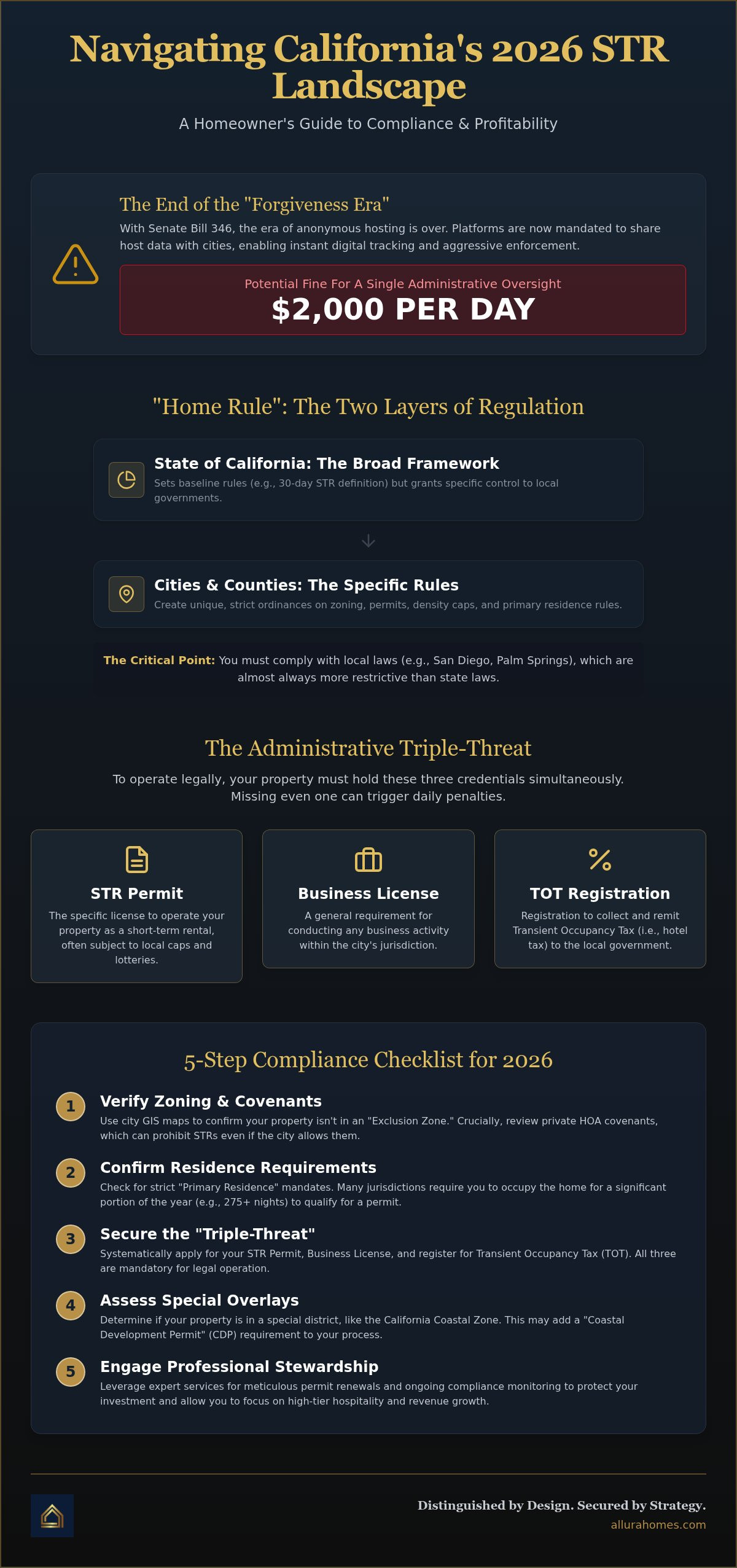
The 2026 STR Permit Checklist: 5 Steps to Legal Operation
The administrative process for navigating California STR zoning laws requires a methodical, sequential approach to avoid the immediate rejection of your application. While the fiscal requirements of taxes and licenses are essential, the permit application itself serves as a rigorous test of your operational diligence. Following a structured roadmap ensures that no detail is overlooked during this high-stakes phase.
Step 1 & 2: The Due Diligence Phase
Before investing in professional photography or safety upgrades, you must confirm your property’s fundamental eligibility. Requesting a formal “Zoning Letter” from the city planning department provides a definitive written record of your property’s status. This document clarifies whether short-term rentals are a “Permitted Use,” which allows for a streamlined approval process, or a “Conditional Use.” A conditional designation often requires a public hearing and discretionary approval from a planning commission, which can add significant time and uncertainty to your timeline.
Simultaneously, you must scrutinize your HOA Covenants, Conditions, and Restrictions (CC&Rs). It’s a common misconception that a municipal permit overrides private neighborhood rules. If your deed contains a private ban on transient rentals, the HOA maintains the legal authority to shut down your operation and impose heavy fines. Professional stewardship involves verifying both public zoning and private restrictions before submitting any formal documentation to the city.
Step 3 & 4: Operational Readiness
Once eligibility is confirmed, you must document your property’s physical capacity with precision. This involves creating a professional floor plan that clearly labels every sleeping room, egress point, and fire safety feature. This plan must align perfectly with the occupancy limits dictated by your specific zoning district. For example, many jurisdictions cap occupancy at two persons per bedroom plus an additional two, but these numbers can fluctuate based on septic capacity or local fire codes.
Modern applications also increasingly require a formal noise-mitigation plan. Utilizing technology like NoiseAware allows you to proactively manage guest behavior without violating their privacy, providing a data-driven approach that demonstrates responsibility to the city. Crucially, you must designate a 24/7 local contact. While some owners attempt to handle this personally, having a professional manager like Allura Homes serve as your contact is the gold standard. This ensures a rapid, professional response to neighborhood issues and significantly reduces your personal liability. To ensure your application is handled with the precision it deserves, consider utilizing our STR compliance and permitting services to navigate these administrative hurdles seamlessly.
Step 5: Submission
The final step is the formal submission of your comprehensive application package along with the required non-refundable processing fee. Ensure every document is meticulously organized and all signatures are notarized where required. In the 2026 regulatory environment, even a minor discrepancy in your site plan or a missing local contact affidavit can result in a denial, often requiring you to wait for a new application window to open.
Professional Stewardship: How Allura Homes Navigates Compliance
The regulatory shifts of 2026 have transformed compliance from a one-time administrative task into a continuous operational requirement. At Allura Homes, we provide a sophisticated, white-glove approach to navigating California STR zoning laws. Our senior-level team handles the meticulous details of permit applications, annual renewals, and local contact requirements, allowing you to enjoy the benefits of your investment without the administrative burden. By treating your property with the same scrutiny as our own, we ensure that every legal requirement is met with precision and transparency.
Legal certainty is the foundation of high-performance revenue. A “clean” listing, backed by a verified and prominently displayed permit number, builds immediate trust with guests and shielding you from the aggressive digital tracking used by municipalities today. Consider our recent success in a high-restriction zone in San Diego. Despite the city’s strict 1 percent cap on whole-home rental permits in certain tiers, our team secured a legal permit for a high-end estate by managing the complex application timing and documentation requirements perfectly. This professional stewardship preserved the owner’s ability to operate in a market where many others were forced to shut down.
Beyond the Permit: Improving Income Legally
Compliance is not just about avoiding fines; it’s a prerequisite for multi-channel listing optimization. In 2026, major booking platforms require verified permit numbers before a listing can go live. Without this “administrative seal of approval,” your property remains invisible to the highest-paying demographic of travelers. Our approach integrates legal adherence with our Full-Service Vacation Rental Management to create an end-to-end experience that prioritizes both safety and yield. We protect your property’s reputation in the community through proactive noise monitoring and local relationship management, ensuring your asset remains a welcomed part of the neighborhood.
Partnering with Allura Homes
Our expertise is deeply rooted in the specific nuances of California’s most desirable markets. From the density caps of Palm Springs and the vineyard mandates of Temecula to the agricultural overlays of Napa and Sonoma, we understand the hyper-local variables that dictate success. We don’t rely on automated systems; instead, our senior-led team provides human accountability and data-driven strategies for every property in our portfolio. This level of dedication is what distinguishes a boutique innovator from a large-scale corporation. If you are ready to secure your property’s future and eliminate the stress of shifting regulations, consult with our compliance experts today to begin your journey toward professional stewardship.
Securing Your Investment in an Evolving Market
The 2026 regulatory environment demands more than a passing interest in local ordinances; it requires a proactive, strategic commitment to legality. Successfully navigating California STR zoning laws is the only way to transform a potential liability into a high-performing, long-term asset. By aligning your property with municipal goals and securing the necessary administrative permits, you protect your portfolio from the volatility of shifting enforcement. You’ve built a significant asset, and maintaining its compliance is the ultimate act of professional stewardship.
You don’t have to manage these complexities alone. With 13 plus years of experience in high-regulation California markets, our senior-level hospitality professionals provide the meticulous oversight your property deserves. We include comprehensive STR permitting and compliance management to ensure every administrative detail is handled with precision. Secure your property’s future with Allura Homes’ compliance services and enjoy the peace of mind that comes from a dedicated professional partnership. Your investment is safe in our hands, and we’re ready to help you thrive.
Frequently Asked Questions
Can I rent my California ADU (Accessory Dwelling Unit) as a short-term rental?
In most California jurisdictions, you can’t use an Accessory Dwelling Unit (ADU) as a short-term rental if it was permitted after January 1, 2020. State law intends for these units to provide long-term housing solutions rather than transient lodging. However, some local ordinances allow exceptions for units built before this date. You should verify your local municipal code to ensure your ADU remains compliant with current housing mandates.
How long does it take to get an STR permit in San Diego or Palm Springs?
The timeline for obtaining a permit varies significantly by city. In San Diego, whole-home permits for non-primary residences are subject to a lottery and density caps, which can lead to extended wait times. Palm Springs applications typically take four to six weeks for processing, provided all safety inspections are passed. Navigating California STR zoning laws during these high-demand periods requires early submission to avoid missing revenue windows.
What happens if I operate a short-term rental without a permit in California?
Operating without a valid permit carries severe financial and legal risks. In Los Angeles, fines can reach 2,000 dollars per day, while Palm Springs imposes penalties up to 5,000 dollars for unauthorized hosting. Beyond the immediate fiscal impact, non-compliance often results in a permanent ban from obtaining future permits. Local municipalities now use advanced digital tracking to identify and penalize unlicensed listings with high precision.
Do zoning laws apply to my Airbnb if I only rent out a single room?
Yes, zoning regulations apply to all transient stays under 30 days, regardless of whether you’re renting a single room or the entire home. Most cities categorize this as “home-sharing.” While these permits often have lower fees and fewer restrictions than whole-home rentals, you must still register with the city and collect the required Transient Occupancy Tax. Failing to do so can lead to citations.
How often do California STR zoning laws change?
Local ordinances are subject to frequent shifts, often changing during annual or biennial city council reviews. These updates typically address density concerns, noise complaints, or housing shortages. Staying informed requires constant vigilance or partnership with a professional manager. We recommend checking for legislative updates every six months to ensure your operating strategy for navigating California STR zoning laws remains aligned with the latest municipal requirements.
Is it possible to appeal a denied STR permit application?
Most jurisdictions provide a formal process to appeal a denied permit application. You typically have a narrow window, often 10 to 15 days, to file a written appeal and pay a secondary processing fee. A successful appeal usually requires proof that the initial denial was based on factual errors or that the property’s since been brought into full compliance with all zoning and safety standards.
Does a “Conditional Use Permit” guarantee I can rent my home forever?
A Conditional Use Permit (CUP) doesn’t provide a permanent guarantee of operation. These permits are discretionary and often include specific expiration dates or conditions that must be met for renewal. The city reserves the right to revoke a CUP if the property becomes a nuisance or if local zoning laws are amended to prohibit short-term rentals in your specific district. It’s a temporary authorization, not a right.
What is the California Coastal Commission’s role in STR zoning?
The California Coastal Commission plays a protective role for homeowners within the Coastal Zone. They generally oppose blanket bans on short-term rentals, viewing them as essential for public access to the shore. However, the Commission still allows cities to implement reasonable regulations and often requires a Coastal Development Permit for new operations. This creates a unique legal middle ground for properties located specifically near the ocean.
Related Articles
Continue reading about this topic.



Need Help Managing Your Rental?
Our team has 13+ years of experience improving revenue for California vacation rental owners.