How to Handle Difficult Vacation Rental Guests: The 2026 Owner's Playbook
 allurahomesSeptember 24, 202613 min read
The most expensive operational mistake a property owner can make isn’t an unexpected repair; it’s reacting emotionally to an unreasonable demand. Learning how to handle difficult vacation rental guests with calm, white-glove professionalism is what separates vulnerable listings from resilient, protected investments.
You likely know the specific exhaustion of a late-night phone alert: an unauthorized gathering upsetting the neighbors, or an aggressive traveler threatening a retaliatory one-star review unless you grant an immediate discount. In high-stakes hospitality, reactive communication rarely works, and it often compromises your property standards or local municipal standing.
Resolving friction doesn’t mean capitulating to unreasonable requests. In this playbook, you’ll discover proven de-escalation frameworks, multi-channel screening protocols, and objective documentation tactics designed to protect your revenue, your physical asset, and your peace of mind. Ahead, we detail the step-by-step operational safeguards that turn high-stress confrontations into controlled, professional resolutions.
Key Takeaways
- Identify early behavioral red flags during pre-booking inquiries to filter out boundary-pushing travelers before reservations are confirmed.
- Master structured de-escalation frameworks on how to handle difficult vacation rental guests, transforming hostile messages into calm, objective resolutions.
- Safeguard municipal permits and neighborhood standing with decisive intervention protocols for unauthorized gatherings, noise spikes, and review extortion.
- Fortify your operational boundaries using legally binding rental agreements and verification systems that deter problematic bookings entirely.
- Weigh the hidden financial and personal toll of midnight self-management against professional white-glove stewardship that protects your asset’s reputation.
Identifying Difficult Vacation Rental Guest Profiles Before Friction Escalates
Professional hospitality begins with proactive threat assessment. Knowing how to handle difficult vacation rental guests starts before a reservation is confirmed, since recognizing behavioral cues early protects your asset from costly disputes and structural wear. By distinguishing genuine maintenance concerns from calculated friction, you maintain control over the guest experience without compromising standards.
The Chronic Complainer and Refund Seeker
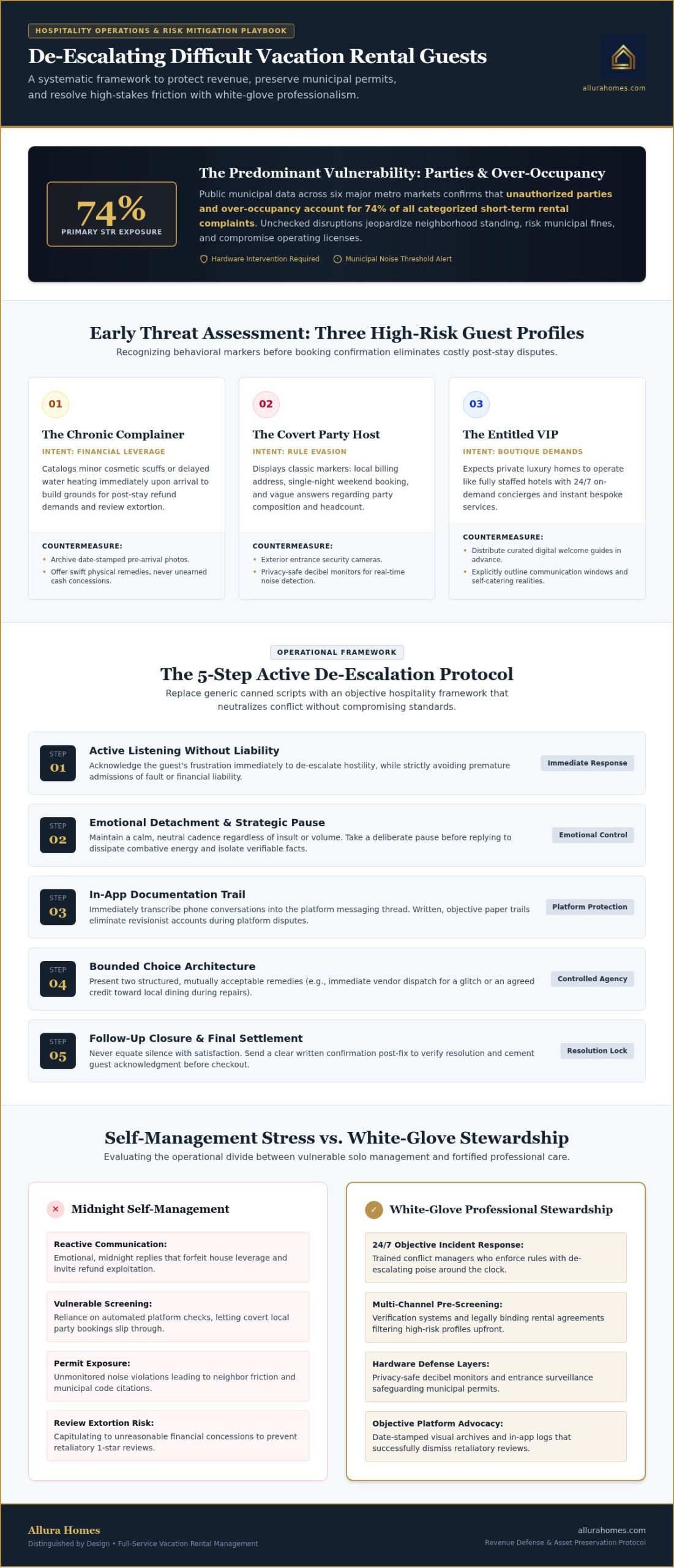
These guests catalog minor cosmetic imperfections immediately upon arrival, such as a faint baseboard scuff or delayed water heating. Their goal is transactional: establishing leverage for post-stay refund demands or review extortion. Protect your revenue by archiving date-stamped, high-resolution photos of the home taken just before check-in. When concerns arise, integrating proven conflict management strategies allows you to acknowledge their perspective politely while offering swift physical remedies rather than unearned cash concessions.
The Covert Party Organizer and Rule Breaker
High-risk reservations often display distinct markers during booking: local addresses, single-night weekend stays, and vague replies regarding party composition. Public data across six major metro markets shows that parties and over-occupancy account for 74% of categorized short-term rental complaints. Mitigate this exposure with hardware safeguards. Exterior entrance cameras and privacy-safe decibel monitors track occupancy anomalies without violating guest privacy. If unauthorized vehicles or sound spikes appear, intervene immediately before municipal noise limits are breached.
The Entitled VIP with Unrealistic Expectations
The 5-Step Protocol for De-Escalating Active Vacation Rental Conflicts
Relying on generic canned replies often backfires when tempers flare. Travelers in distress want to feel heard, not deflected by automated scripts. Knowing how to handle difficult vacation rental guests during an active dispute requires methodical poise and strict adherence to a hospitality-first protocol. Given the widespread industry problems surrounding guest disputes and unmet expectations, establishing an objective resolution framework protects both your reviews and your bottom line.
Step 1 & 2: Practicing Active Listening and Emotional Detachment
Acknowledge the guest’s frustration immediately while avoiding premature admissions of fault or liability. Hostile language is usually an emotional reaction to feeling stranded or unheard. Maintain a calm, neutral cadence regardless of their volume or insults. Take a deliberate pause before replying. This brief silence dissipates combative energy, helping you evaluate the real operational facts rather than defending wounded pride.
Step 3 & 4: In-App Documentation and Offering Bounded Options
If an exchange takes place over the phone, transcribe the key details into the platform messaging thread immediately. Objective paper trails prevent revisionist narratives later. Next, present the guest with two bounded, mutually acceptable remedies. For example, offer immediate vendor dispatch for a mechanical glitch or an agreed credit toward local dining while repairs take place. Providing structured choices restores the guest’s sense of agency without compromising house policies. For owners who prefer not fielding these delicate exchanges, partnering with a full-service vacation rental management team ensures experienced professionals manage guest relations around the clock.
Step 5: Follow-Up Closure and Final Settlement
Never assume silence equals satisfaction. Once an issue is fixed, send a brief confirmation message: “Confirming that the technician restored the cooling system and the home is comfortable.” Securing explicit written agreement closes the service loop, neutralizes post-checkout compensation demands, and creates an ironclad archive if an online travel agency claim ever arises.
Navigating High-Stakes Emergencies: Noise Violations, Evictions, and Blackmail
When operational friction crosses the threshold into safety threats, property damage, or municipal violations, standard hospitality courtesies are no longer sufficient. Property owners must know how to handle difficult vacation rental guests through disciplined, lawful actions that protect licensing permits and community goodwill. Generic advice often overlooks the complex regulatory liabilities tied to short-term rentals, where a single mishandled neighborhood disturbance can trigger administrative fines or permit revocation.
Enforcing Noise Ordinances and Neighborhood Harmony
Strict noise regulations across Southern California and Wine Country require rapid intervention. In communities like Palm Springs or San Diego, decibel limits are actively monitored and enforced by local code compliance teams. Reviewing local frameworks like the Temecula short term rental laws highlights how quickly unauthorized events jeopardize operating status. Enforce compliance using a progressive warning structure: an automated text alert upon initial threshold detection, a direct phone call within five minutes, and professional on-site dispatch if excessive sound levels continue past ten minutes.
Neutralizing Review Extortion and Financial Threats
Few operational challenges are as stressful as a traveler demanding unwarranted cash concessions while holding a one-star review over your head. Platform terms of service explicitly prohibit this conduct. To build an airtight defense:
- Keep every communication channel inside the platform app so timestamps and statements are permanently locked.
- Preserve explicit message records if a guest links refunds to their review rating.
- Submit your compiled dossier to platform safety teams immediately, requesting early review blocking under anti-extortion policies.
Executing Safe and Lawful Guest Evictions
Personal confrontation at midnight is dangerous and ill-advised. Understanding how to handle difficult vacation rental guests during an eviction requires clear operational separation. First, notify the booking channel safety division that the guest has broken critical house rules, such as hosting unauthorized gatherings or violating occupancy limits. Request an immediate cancellation of the stay, which legally revokes their status as authorized occupants. Then, deploy professional property managers or licensed private security to oversee departure peacefully, preventing property damage without exposing homeowners to physical danger.
Proactive Guest Screening: Filtering Problematic Renters Before Check-In
The most elegant solution to contentious guest management is prevention. While knowing how to handle difficult vacation rental guests during an active stay is essential, building systematic filters before confirming a booking stops high-risk travelers at the gate. According to a 2024 survey by Charge Automation, 43.9% of short-term rental operators cite property damage as a primary operational fear. Relying solely on basic platform verification leaves homes exposed to significant financial and physical risk.
Multi-Tiered Guest Verification Protocols
Elevate your screening beyond basic profile checks. Implement automated identity verification requiring a government-issued photo ID that matches the credit card billing name down to the character. Review cross-platform feedback with scrutiny, looking past the star rating to note host commentary regarding cleanliness or unauthorized visitors. Where local fair housing regulations permit for short-term vacation rentals, enforcing a minimum booking age of 25 naturally deters transient, celebratory gatherings without reducing family bookings.
Ironclad Rental Agreements and Clear Expectations
Never rely strictly on standard platform terms to safeguard high-value real estate. Require primary guests to sign a formal digital rental agreement that establishes clear operational boundaries before door codes are released:
- Visitor policies: Explicit limits on unapproved daytime visitors and strict maximum vehicle caps per driveway stall.
- Specific quiet hours: Binding quiet hours aligned with municipal code, usually 10:00 PM to 7:00 AM.
- Liquidated fees: Transparent fee schedules detailing financial charges for interior smoking, unapproved pets, or excessive trash.
Smart Technology Deployment for Passive Property Defense
Protecting an asset doesn’t require invading a traveler’s retreat. Exterior doorbell cameras provide objective verification of headcount at the front threshold, while privacy-safe decibel hardware measures noise trends inside living areas without recording conversations. Synchronized smart locks complete the system by automatically activating codes precisely at check-in time and revoking them immediately at checkout. To safeguard your home with institutional-grade verification, explore full-service vacation rental management tailored to high-end properties.
Self-Management Stress vs. White-Glove Professional Guest Stewardship
DIY management promises total operational control, yet it often demands an unsustainable personal toll. Mastering how to handle difficult vacation rental guests on your own requires round-the-clock availability, constant legal awareness, and the emotional stamina to navigate hostile demands. Software automations can send scheduled check-in codes, but code cannot defuse an aggressive guest on a dark patio or manage an urgent municipal complaint.
The True Cost of Middle-of-the-Night Host Burnout
Host fatigue compounds quickly when contentious travelers disrupt your personal life. Consider the hours consumed de-escalating irrational maintenance grievances, coordinating emergency trades, or disputing bad-faith refund requests. A single unaddressed guest conflict can spark a retaliatory one-star review, depressing listing ranking in search algorithms and reducing forward occupancy. Exploring modern short-term rental property management offers a proven path to reclaim your personal freedom while safeguarding your asset’s income.
Local Hospitality Teams as the Ultimate Defense Buffer
True asset protection requires hands-on operational capability. Local management teams act as a protective buffer between high-stakes property owners and confrontational guests. This boots-on-the-ground presence delivers critical advantages:
- Physical intervention: Experienced hospitality professionals handle face-to-face tenant disputes directly, eliminating physical risk for property owners.
- Municipal relationships: Direct lines of communication with neighborhood associations and local code compliance officials defuse friction before fines are issued.
- Brand equity preservation: Swift resolution of legitimate maintenance issues protects review scores and preserves Superhost or Premier Host status.
Elevating Your Vacation Rental with Allura Homes
Protecting a premium asset shouldn’t come at the expense of your peace of mind. With over 13 years of hospitality and property management experience, Allura Homes provides high-touch management across San Diego, Temecula, Palm Springs, Napa, and Sonoma. Our dedicated 24/7 professional guest response team, strict multi-channel screening, and quiet-hours compliance protocols ensure you never have to master how to handle difficult vacation rental guests alone. Review our comprehensive guide to full-service vacation rental management, or connect with our team today for a confidential consultation.
Elevate Your Hospitality Strategy and Reclaim Your Peace of Mind
Safeguarding your short-term rental investment demands more than reactive damage control. By uniting multi-tiered identity screening, binding rental contracts, and objective de-escalation frameworks, you insulate your asset against operational chaos, bad-faith refund demands, and local compliance fines. Ultimately, understanding how to handle difficult vacation rental guests isn’t about appeasing unreasonable demands. It’s about setting authoritative boundaries that command respect from the initial booking inquiry to post-stay checkout.
You don’t have to carry the mental strain of midnight disputes or volatile confrontations alone. Backed by over 13 years of hospitality expertise, Allura Homes provides rapid on-the-ground support, strict quiet-hours compliance, and dedicated 24/7 guest response teams across Southern California and Wine Country. Protect your property and eliminate hosting stress with Allura Homes, ensuring your high-end rental operates seamlessly while you enjoy true peace of mind.
Frequently Asked Questions
How do I handle a vacation rental guest who refuses to leave after checkout?
Contact the guest immediately via platform messaging to state that their checkout window has expired and entry codes have deactivated. If they remain unresponsive or refuse to vacate, notify platform safety teams to formally cancel the reservation and terminate their legal occupancy status. For properties in markets like San Diego or Palm Springs, dispatching local on-the-ground management or private security ensures an orderly departure without escalating into personal conflict.
Can an Airbnb guest leave a bad review if they broke house rules?
Yes, guests can technically submit a review, but platform policies protect hosts from retaliatory feedback when documented house rules are broken. If a guest violates quiet hours, exceeds occupancy limits, or brings unauthorized pets, submit your smart lock logs, decibel reports, and camera timestamps to customer support. Platform representatives will strike the review if the guest’s negative comments stem directly from rule enforcement actions.
What is the best way to respond to unreasonable discount demands during a stay?
Respond promptly with empathy, acknowledge their specific frustration, and offer a bounded operational remedy rather than unearned cash concessions. Dispatch an emergency maintenance vendor immediately if a mechanical system fails, or provide a modest local dining credit while repairs occur. Declining unwarranted cash refunds professionally sets a firm boundary, ensuring your revenue remains protected while showing the platform you acted in good faith.
Are hosts allowed to use noise-monitoring devices inside short-term rentals?
Hosts are permitted to install indoor decibel-monitoring hardware as long as the devices do not record audio, capture conversations, or contain cameras. These smart sensors measure volume levels in decibels and track duration trends passively. Always disclose these devices explicitly in your listing description and house rules to maintain platform transparency and ensure compliance with municipal ordinances across California vacation destinations.
How can I legally evict a guest throwing an unauthorized party?
Evicting an unruly group begins by contacting the booking platform safety department to cancel the reservation for serious rule violations. Canceling the stay immediately revokes their legal status as authorized occupants. Avoid confronting large crowds alone late at night. Instead, deploy professional property managers or licensed private security personnel to oversee a peaceful departure, protecting your home and preserving relationships with local neighborhood compliance officers.
What should I do if a guest threatens a negative review unless I refund them?
Keep all communication strictly within the booking platform’s messaging system and never concede to the demand. Review extortion directly violates the terms of service on Airbnb and Vrbo. Preserve written screenshots of the guest’s threats linking review ratings to financial compensation. Send this documentation directly to platform safety representatives, who will flag the user and ensure any retaliatory review is permanently barred from publication.
Does professional property management protect owners from difficult guest liability?
Professional management serves as a protective buffer between high-stakes property owners and contentious travelers. Knowing how to handle difficult vacation rental guests involves constant vigilance, strict identity verification, and rapid on-the-ground crisis response. Full-service firms like Allura Homes provide 24/7 dedicated guest support, sound-monitoring compliance, and local teams across Napa, Sonoma, and Southern California to resolve disputes before municipal fines or listing penalties occur.
Related Articles
Continue reading about this topic.



Need Help Managing Your Rental?
Our team has 13+ years of experience improving revenue for California vacation rental owners.