San Diego short term rental management costs and rules
 allurahomesNovember 28, 202612 min read
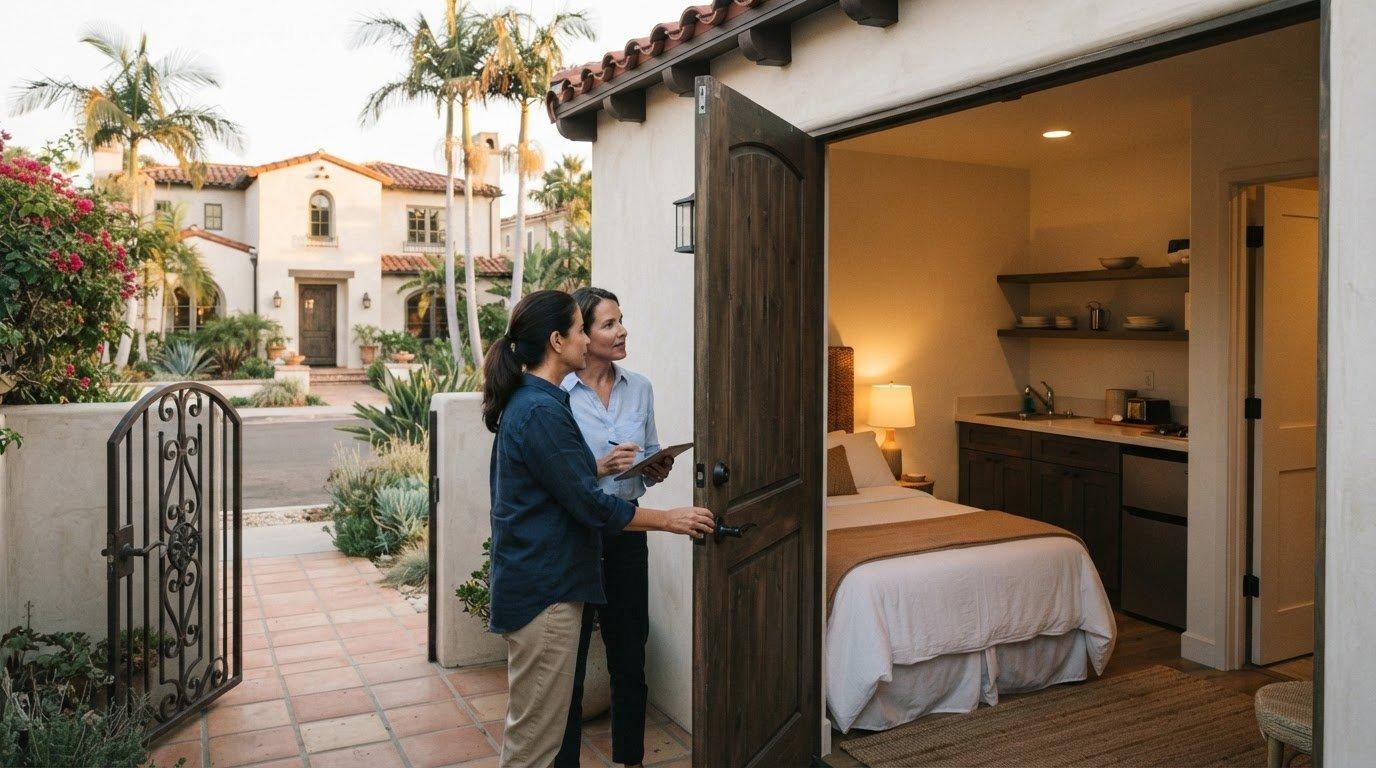
For San Diego-area owners assessing a property in nearby Coronado, the first question is whether short stays are allowed. In a Coronado residential zone, renting a dwelling or habitable unit for 25 consecutive calendar days or less is prohibited; the shortest lawful residential stay is 26 consecutive days, subject to stricter rules. A room may face the same limit if it qualifies as a habitable unit. Understanding this distinction is central to evaluating Coronado short-term rental management.
Coronado has its own rules, so San Diego’s requirements do not automatically apply across the city boundary. Before assessing a rental opportunity, consider the property’s location and type, along with taxes, management costs, HOA restrictions, and lease terms. This guide explains the key differences for owners comparing Coronado with the wider San Diego area and outlines factors that shape a practical rental plan.
Key Takeaways
- Determine whether your room or unit qualifies as a residential rental and which minimum-stay rules apply before planning short stays.
- Separate property taxes, occupancy taxes, and management fees to understand the different costs that can shape rental income.
- Compare Coronado’s requirements with San Diego’s rather than assuming nearby cities follow the same licensing framework.
- Review HOA restrictions and lease terms alongside city rules, since association limits may further narrow your rental options.
1. Do San Diego’s short-term rental rules apply in Coronado?
No. Coronado has its own zoning rules, so San Diego’s short-term rental framework doesn’t replace Coronado’s restrictions. In a residential zone, renting a dwelling or habitable unit for 25 consecutive calendar days or less is prohibited. The shortest lawful residential rental stay is 26 consecutive days, subject to stricter applicable rules. A room may be covered if it qualifies as a habitable unit.
This distinction matters for owners considering nightly or weekly bookings. Coronado’s 10 percent transient occupancy tax applies to occupancy of 25 consecutive days or less, but paying tax doesn’t make a prohibited residential rental lawful. The tax doesn’t apply to residential landlords renting for 26 days or more. Owners renting two or fewer residential dwelling units don’t need a city business certificate; those renting three or more are subject to the city’s business certificate rules.
Accessory units have additional limits. California state law requires ADU rentals to be for a term longer than 30 days, effective January 1, 2026. Coronado’s codified rule requires ADU and JADU rentals to last six consecutive months or more. Ordinance No. 2026-08, which amends parts of the city’s ADU code, took effect November 5, 2026. A home’s unit type can therefore change the minimum rental term.
Reviews alone do not show how well a management company performs. Compare recurring feedback with the quality of its reporting and listings, as well as its compliance practices. A management contract should spell out the service scope, fees, cancellation terms, booking authority, and responsibility for regulatory tasks.
Risks include zoning enforcement: under CMC § 86.54.310, the Director of Community Development enforces the zoning title, and each separate day or portion of a day of violation is a separate offense. CMC § 86.54.320 makes uses contrary to the zoning title unlawful and a public nuisance; insurance and liability exposure depend on the property, rental arrangement, and policy terms.
2. Property taxes and property management fees
For owners evaluating Coronado short term rental management, separate property tax, rental-related charges, and operating expenses in the forecast. San Diego County effective property tax rates often fall around 1.0 to 1.3 percent of assessed value. One estimate applies a 1.2 percent rate to a $3.149 million Coronado purchase, producing about $37,800 in annual property tax. That example is a planning illustration; assessed value determines the calculation.
Management fees vary by rental model and how the agreement calculates revenue. Long-term property managers commonly charge about 8 to 12 percent of collected rent, while full-service short-stay managers commonly charge 15 to 30 percent of gross booking revenue. These are industry ranges, not a quote for any specific property or provider. Review the contract’s fee basis and included services before estimating the owner’s net proceeds.
Managers assess a property’s features, comparable listings, booking patterns, and seasonal demand when setting prices and planning marketing. A revenue projection should weigh achievable rates against expected occupancy and operating expenses. Asking prices alone do not reveal likely net income. For Coronado short term rental management, listing distribution and a clear, accurate presentation also affect a property’s visibility to prospective guests.
Keep advertised rents separate from management charges. These are asking prices, not guaranteed booking rates or owner returns.
License costs depend on the city’s rules. San Diego’s application fee for a whole-home short-term rental license can be as high as $1,000 per unit; that is a San Diego figure, not a stated Coronado charge. Build a property-level forecast with separate lines for taxes, applicable license costs, management, and listing-related charges. This gives you a clearer basis for comparing rental scenarios.
3. Differences between Coronado and San Diego rules
Coronado and San Diego set different frameworks, so a license or rental strategy for one city doesn’t automatically transfer to the other. San Diego’s ordinance limits short-term rentals to 1% of the city’s 540,000 housing units, or 6,500 licenses. That cap belongs to San Diego; it isn’t a Coronado-wide allocation. Owners should identify the property’s city before applying rules or forecasting whether a license is available.
Coronado’s additional-unit rules create a separate distinction. The city’s codified rule requires ADU and JADU rentals to last six consecutive months or more, as of October 19, 2026. Coronado’s SB 9 two-unit developments may only be rented for terms longer than 30 days. These provisions address different housing types, so the unit’s legal category affects which minimum term applies.
California law adds another layer for ADUs: rentals must be for a term longer than 30 days, effective January 1, 2026. Coronado Ordinance No. 2026-08, which amends parts of the city’s ADU code, takes effect November 5, 2026. The state requirement and Coronado’s six-month rule should be read together, not treated as interchangeable. For an ADU or JADU, the stricter local duration may shape the practical rental plan.
San Diego’s licensing cap differs from Coronado’s business-certificate threshold. In Coronado, owners renting two or fewer residential dwelling units do not need a city business certificate; owners renting three or more are subject to the city’s business-certificate rules. This certificate requirement is not the same as San Diego’s license cap. The property’s location, unit type, and number of residential units all affect which rules apply.
For a portfolio spanning both cities, keep a separate compliance record for each property and municipality. A San Diego license does not establish permission to operate in Coronado, and Coronado’s local rental-duration rules do not determine eligibility in San Diego. Treating neighboring cities as separate regulatory markets helps owners avoid applying one city’s rules to another.

4. HOA rental restrictions and lease terms
City rules are only one layer of rental limits. A homeowners association’s governing documents may impose additional restrictions, so a rental period allowed by local rules may still conflict with an HOA requirement. In the Coronado Cays, the homeowners association handbook prohibits rentals or leases of 26 consecutive calendar days or less. That restriction can affect the permitted lease length even when the property otherwise meets city requirements.
California Civil Code sections 4740 to 4741 address protections and procedural requirements related to HOA rental restrictions. A California HOA may prohibit transient or short-term rentals of 30 days or less, and it may not cap rentals at less than 25% of separate interests. These provisions concern different types of limits: a minimum lease duration is not the same as a cap on how many homes may be rented. Owners should read the specific restriction carefully.
Rental paperwork also has defined information requirements. Under § 4740(c), an owner renting property in an HOA must provide the association verification of the title acquisition date and the tenant’s name and contact information. Build that disclosure into the leasing process, and keep records showing the rental term and tenant details. Those records help align the lease with association procedures.
Lease terms should clearly state the rental duration, occupancy dates, rent, and responsibilities agreed between the parties. The HOA’s rules, the property’s legal rental category, and any applicable city restriction can each affect the allowable term. For a property in the Coronado Cays, for example, a lease of 26 consecutive calendar days or less conflicts with the handbook’s restriction. A management agreement is separate: it should explain the manager’s authority, service scope, and how rental operations are handled.
For owners who want professional support coordinating rental operations with applicable property requirements, explore full-service vacation rental management.
Allura Homes: Full-Service Vacation Rental Management
Allura Homes provides full-service vacation rental management, including market analysis and revenue projections to help owners assess a property’s rental potential. Multi-channel listing optimization supports the property’s presentation across booking platforms, while STR compliance and permitting services help owners navigate local requirements. Allura Homes serves owners in San Diego, Temecula, Palm Springs, Napa, and Sonoma; property owners in nearby coastal areas like Coronado should first establish which specific municipal rental rules apply to their location.
This support is most relevant once you have established the applicable rental terms and considered any HOA limits. If local rules do not allow a property to be rented on a short-term basis, it may not suit a vacation-rental plan. Resolve compliance questions before marketing. For eligible properties, coordinated management can bring planning, listing strategy, and regulatory support together.
Contact Allura Homes to discuss vacation rental management for your property.
Make your next rental decision with a clear plan
Turn your property’s eligibility and financial picture into an operating plan that fits your goals. Decide whether the property is intended for permitted vacation stays or a longer rental arrangement, then align marketing and management expectations with that choice. A defined plan helps you assess the property as an investment without letting projected revenue overshadow restrictions or operating costs.
Professional Coronado short-term rental management can help owners assess potential performance and develop a listing strategy, but the right approach depends on the property and the rental model it can lawfully support. If short-term renting is not permitted for your unit, a different lease strategy may be more suitable.
For a tailored discussion of your property and vacation-rental goals, contact Allura Homes. A thoughtful plan can make your next decision more deliberate and give your property strategy a confident direction.
Frequently Asked Questions
Can I rent a room in my Coronado home on a short-term rental site?
Not for stays of 25 consecutive calendar days or less if the room qualifies as a dwelling or habitable unit in a residential zone. A listing platform doesn’t change that local restriction. For a room that isn’t clearly a separate habitable unit, the property’s layout and legal classification matter. Owners should also account for applicable HOA terms, which can be stricter than city rules.
Do San Diego’s short-term rental rules apply in Coronado?
No. Coronado properties are governed by Coronado’s zoning and rental requirements, not San Diego’s licensing framework. A San Diego license does not authorize a rental in Coronado. San Diego’s citywide license cap applies to properties within that city, while Coronado applies its own rules according to property type and location. Keep each property’s municipality clear in rental records and management plans.
How about the local real estate market?
Coronado combines high property values with substantial asking rents, so a market assessment should weigh expected income against acquisition and operating costs. These indicators describe different parts of the market; neither alone establishes a property’s likely revenue or investment return.
What does this mean for the Coronado rental market?
Rental strategy depends on what a property can legally accommodate, not just on demand or nearby asking prices. A home suited to longer stays may need a different operating plan from a unit eligible for vacation use. Compare realistic rental income with ownership costs, permitted lease terms, and association restrictions. Owners also considering San Diego, Temecula, Palm Springs, Napa, or Sonoma should assess each market separately.
What is the minimum rental period in Coronado?
For a dwelling or habitable unit in a residential zone, the shortest lawful residential rental stay is 26 consecutive days, subject to stricter applicable rules. ADUs and JADUs have a separate local requirement of six consecutive months or more. SB 9 two-unit developments may only be rented for terms longer than 30 days. The applicable minimum depends on the property’s legal category.
Which Coronado, California short-term rental rules and permits apply to vacation rentals?
Requirements depend on property type, rental duration, and the number of residential units rented. Owners renting two or fewer residential dwelling units do not need a city business certificate; owners renting three or more are subject to the city’s business-certificate rules. ADU and JADU rental terms have separate limits. Coronado’s time-share ordinance also prohibits establishing or converting dwelling or habitable units for time-share use in every zone.
Related Articles
Continue reading about this topic.



Need Help Managing Your Rental?
Our team has 13+ years of experience improving revenue for California vacation rental owners.